








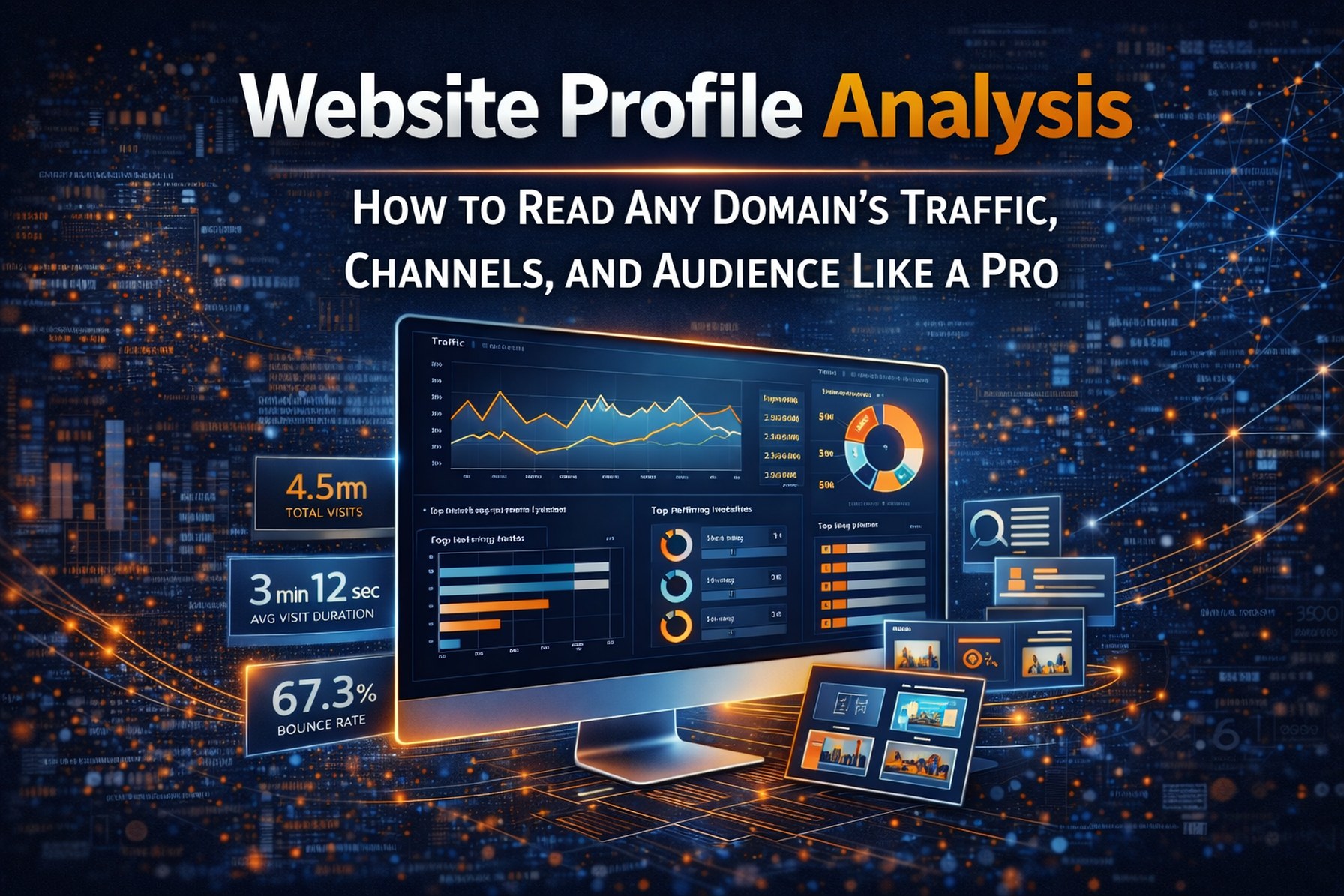
A website profile page is the fastest way to understand a domain’s digital performance without guessing. In one view, you can estimate traffic volume, compare channel mix, evaluate engagement quality, spot top referral sources, and identify audience interests. When you learn how to read a domain profile correctly, you can benchmark competitors, validate marketing decisions, and build a smarter growth plan backed by behavior signals.
A high-quality domain profile typically combines traffic estimates with context. It’s not just “how many visits.” It’s why the visits happen and what the audience does next.
- - Traffic overview with trend direction and stability
- - Engagement signals like time on site, pages per visit, and bounce behavior
- - Traffic sources showing distribution channels and dependency risks
- - Top keywords that reveal demand and intent
- - Referrals that show where discovery happens
- - Audience interests and category alignment for targeting ideas
These sections work together like a diagnostic report: you can quickly see what’s strong, what’s fragile, and what’s scalable.
Start With Trend, Not Total
Total visits can be impressive and still meaningless for strategy. Trend reveals the real story.
- - Rising trend suggests demand capture or stronger distribution
- - Flat trend suggests stable demand but limited momentum
- - Falling trend suggests a visibility loss or demand shift
Always interpret traffic as a direction and pattern, not a single number.
Watch for Seasonality and Spikes
Some sites peak during predictable cycles. Others spike due to one campaign or one viral event.
- - Repeating peaks often indicate seasonal demand
- - One-time spikes often indicate campaigns, mentions, or short bursts
- - Slow steady climbs often indicate compounding SEO and brand growth
Engagement answers the question: Do visitors actually care? When engagement is weak, growth can be fragile. When engagement is strong, growth often compounds.
Time on Site
- - Low time often indicates intent mismatch, weak content, or UX friction
- - Healthy time suggests research behavior and strong relevance
Pages per Visit
- - Low pages can signal dead ends, thin pages, or weak internal linking
- - Higher pages often indicates useful depth and clear user paths
Bounce Behavior
- - High bounce can mean slow pages, misleading titles, or weak first-screen value
- - Lower bounce often means users found what they expected and continued
The best insights come from combining signals: traffic trend + engagement trend = real momentum.
Channel distribution shows where a site’s traffic comes from and how dependent it is on a single source.
- - Search-led growth often means content depth and intent capture
- - Direct-led growth often means brand strength and returning users
- - Referral-led growth often means partnerships, mentions, or ecosystem traffic
- - Social-led growth often means shareable content and community distribution
- - Paid-led growth often means scalable acquisition with optimized funnels
Dependency Risk Check
If one channel dominates, the business can be vulnerable. A channel mix with multiple strong sources is usually more resilient.
- - Single-channel dominance can collapse if algorithms or costs shift
- - Balanced mix is harder to disrupt and easier to scale
Keyword Insights
Keywords reveal intent. The most useful approach is grouping them into clusters.
- - Problem-aware: users searching for solutions and explanations
- - Solution-aware: users comparing tools, platforms, and methods
- - Comparison: users deciding between alternatives
- - Transactional: users ready to buy or subscribe
When you see which cluster drives discovery, you can design a content roadmap with fewer wrong bets.
Referral Insights
Referrals show where trust is borrowed. The best referrals don’t just create links—they send qualified visitors.
- - Reviews and comparisons often send high-intent traffic
- - Industry publishers can create sustained discovery
- - Partners and integrations can send repeat traffic at scale
You can benchmark a competitor quickly by reading their profile in this order:
- - Trend: are they growing or declining?
- - Engagement: is the traffic valuable or weak?
- - Channel mix: what engine drives them?
- - Keywords: what intent do they capture best?
- - Referrals: where do they borrow trust?
This sequence prevents “copying blindly” and helps you build an original plan that still learns from proven patterns.
- - Focusing on visits only and ignoring engagement quality
- - Comparing unrelated sites instead of a real competitor set
- - Overreacting to one spike instead of tracking sustained trends
- - Ignoring channel dependency and missing risk signals
A domain profile is a decision tool when you read it as a system, not a screenshot.
A well-read website profile gives you a clear growth compass: what drives traffic, what keeps users engaged, what channels dominate, and where discovery happens. When you combine trend, engagement, channel mix, keywords, and referrals, you can build a practical plan: improve intent match, strengthen distribution, fix engagement leaks, and target segments where competitors are weak. That’s how domain research becomes measurable progress.